


Photo credit: Prishaa Rajalathan
By Prishaa Rajalathan, MDP
In my last blog, I wrote that mobilizing finance is a capability problem before it is a money problem, and that capability gets built one concept note at a time. This final dispatch picks up from there. Once the money arrives, or once a country decides to raise its own, how does it know where that money actually goes?
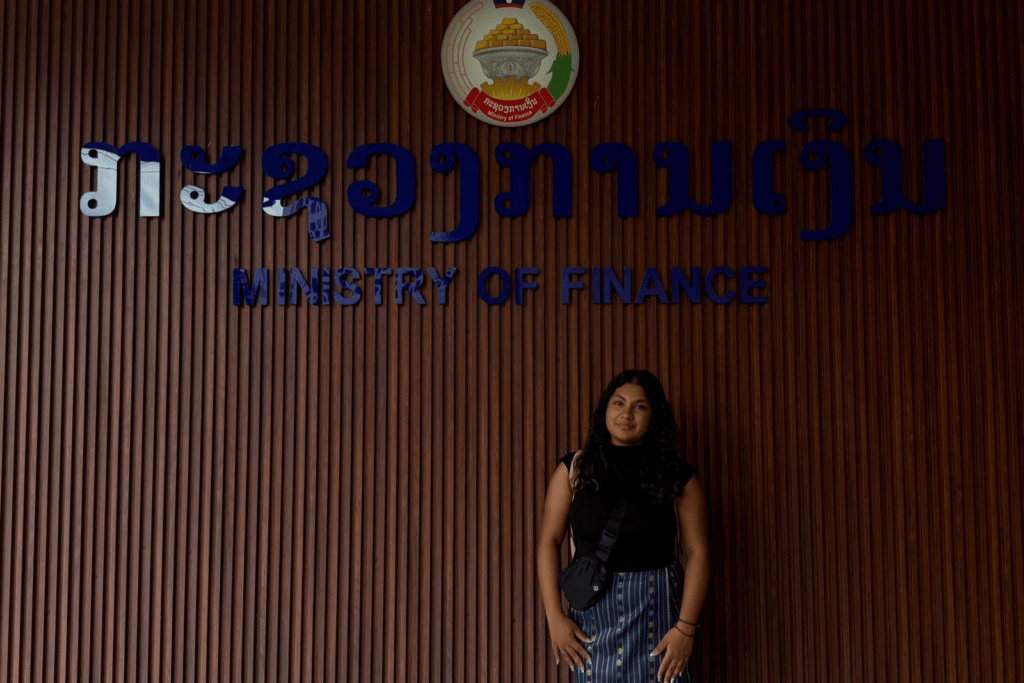
On my very last day, August 14th, the Climate and Sustainable Finance Hub, where I spent my placement, hosted a training workshop at the Ministry of Finance on climate and green budget tagging. The workshop brought together staff from across the Ministry of Finance, line ministries covering agriculture, public works, health, and more, as well as partners from UNDP, ADB, the World Bank, the IMF, and UNEP. It was one of the last things I attended before wrapping up, and a fitting way to end my placement because it brought together so much of what I had been exposed to over the previous few months.
Climate budget tagging sounds technical, and it is. Stripped down, it is a way for a government to look at its own budget and answer a fairly simple question: how much of this spending actually supports climate goals? Right now, Lao PDR cannot answer that with much precision. The World Bank’s 2025 assessment found that the country’s public financial management system does not yet systematically account for climate. Climate risks are not fully reflected in budget processes, and the tools needed to tag and track climate-related spending are not yet built into the legal and budget framework.
That gap carries a cost. Lao PDR’s updated climate targets come with a financing need of more than thirty billion dollars, and only a small share of that is expected to come from the national budget. The rest depends heavily on international climate finance. Increasingly, those funders want to see that countries have systems in place to identify, classify, and report where climate spending is going. Tagging is part of how a government can build that confidence.
At its simplest, tagging turns a government budget into something that can actually be read for its climate content. It allows the government to see how much of its own money is going toward the goals it has committed to, rather than treating climate finance as something that only exists in separate projects or donor programmes.
That visibility matters in both directions. It gives funders greater confidence that climate spending can be tracked and accounted for, while also giving the government a clearer picture of where its own spending is falling short of its climate plans. Getting there is largely a coordination issue. Fiscal and line ministries need to agree on what counts as climate spending and how those numbers should be recorded and reported. Much of the workshop focused on exactly that.
This is where the day connected back to the paper I have spent much of my placement working on a study of carbon tax and environmental fiscal reform options for Lao PDR. A carbon tax can raise revenue, but the harder question has always been what happens to that revenue afterward. Recycling it into green programmes, household support, or other priorities is part of what can make the policy fair and politically durable.
But none of that is particularly meaningful if you cannot see or verify where the money goes.
Fiscal reform can help raise the money, while budget tagging helps show whether it is reaching the places and priorities it was intended for. One creates the resources, the other creates the visibility. They are different pieces of the same system.
Over these four months, my understanding of climate finance has changed. I started by thinking about climate action largely in terms of projects and funding. I leave seeing it as a system. Communities need to be part of the decisions, governments need the capability to turn priorities into credible proposals, and institutions need the tools to follow resources through the budget and into results.
That is the lesson I will carry with me most, climate finance is not just about finding the money. It is about building the systems that make that money useful, accountable and connected to the people and priorities it is meant to serve.
The opinions expressed in this article are those of the author(s) and do not necessarily reflect the views of the BSIA, its students, faculty, staff, or Board of Directors.