


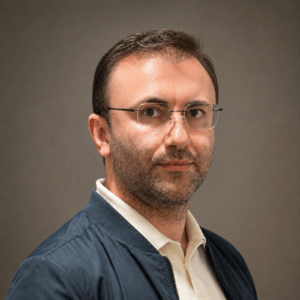
What attracted you to your program of study at the BSIA?
In the shortest sense, it was the possibility of becoming a new version of myself.
More broadly, I had reached a point that, borrowing Homer’s language, I would describe as polytropic. My path had never unfolded in a conventionally linear way, and neither had my thinking. Thinking needs a place in order not to become displaced. Therefore, what attracted me first was actually the Balsillie School itself, not merely a particular program. Although, of course, it was also quite a nice opportunity to challenge myself by unexpectedly becoming a student again. Studying had always been something personally close to me.
At that time, I was doing independent research on geopolitical issues connected to the Russo-Ukrainian war. At a certain point, I realized that I wanted my analysis to move beyond research for its own sake. Living in the Toronto area back that time, I explored many of the programs connected to international affairs and policy analysis. Some were excellent institutions, but many of them felt quite traditional or academically compartmentalized for what I was looking for.
I came across the Balsillie School almost by chance. I started reading about its work, reached out to people connected with the school, and very quickly had the sense that this was a different kind of institution.
What stood out to me was that BSIA seemed to think naturally in terms of emerging issues. It was asking questions about the challenges of the twenty-first century — technology, security, global governance, migration, economic transformation, new forms of conflict — in a way that felt much more forward-looking and interconnected than many of the programs I had explored.
I remember thinking that this felt like a school of the future.
It was also still a relatively young institution, and that was attractive to me. There was a sense of intellectual openness and growth — people coming from very different disciplinary, professional, and cultural backgrounds, exchanging ideas and shaping the environment together rather than simply entering a very established academic tradition.
So, in a way, I was attracted not only to a degree. I wanted to immerse myself in the perspective of the institution itself — in that combination of rigorous analysis, openness to emerging problems, and a real concern with policy impact. That was what ultimately brought me to BSIA.
What exactly do you do in your position?
A large part of my work is about helping an organization understand uncertainty before that uncertainty becomes a problem.
In practical terms, as a project lead, I work with different parts of the Public Service Commission to identify emerging risks, assess their potential impact, and bring that information together into a coherent picture for senior management. That can involve technology modernization, workforce pressures, financial constraints, service delivery, or broader government-wide changes.
What makes the work interesting is that risk management is not really about filling out a risk heatmap or developing a risk assessment tool from scratch. The important part is the conversation behind it.
You may have one group looking at an issue from an operational perspective and another from a strategic one. My role is often to connect those perspectives and derive analytically strong, reliable value and insight to support executive decision-making.
What was the most impactful experience during your Master’s degree?
What had the greatest impact on me, and really helped consolidate my knowledge and skills, was the very clear pragmatic dimension that BSIA offered through its different clusters and practice-oriented components, especially toward the end of the program.
One particularly valuable part was the policy writing component, because it pushed you to translate analysis into a form that could actually be useful to decision-makers.
A very time-sensitive and important experience for me was working as an analyst at the Waterloo Security Dialogue, where I prepared a detailed synopsis of the conference and presented it to CIGI. That kind of work required listening carefully, identifying what actually mattered, structuring a large amount of information quickly, and turning it into something coherent and useful for a professional policy audience.
Another especially important experience was conducting policy research with BSIA’s Cluster on AI, Ethics, and Warfare. In that context, I worked on AI-backed disinformation related to the Russo-Ukrainian war, with a particular focus on narratives circulating in Canadian social media. The work also led to a follow-up publication developed with colleagues.
For me, this practical dimension was especially important because once you apply knowledge in a real context, it becomes much more firmly grounded. You begin to see the field more clearly, understand the limits of your own analysis, and, perhaps most importantly, see what the next question should be and where your own development can go from there.
Tell us about your job. How are you making a difference?
One thing I have learned in government is that “impact” is often quieter than people imagine.
It is not always a major announcement or a policy with your name attached to it. Sometimes impact means making sure that the right question reaches the right decision-maker before a problem becomes urgent.
In my current role, for example, I work on corporate risks management that can ultimately affect how the Public Service Commission supports departments and public servants across the federal government.
The human dimension can easily disappear when these issues are described only through numbers and risk ratings. But behind a “capacity risk,” for example, are people who may be waiting for a staffing process, a service, a decision or support during a period of organizational change.
So one of the things I try to bring into my work is that connection between institutional analysis and real consequences.
Earlier in my federal career, I saw the same principle from another angle while working on sanctions and foreign interference issues at Global Affairs Canada. Those files can appear highly geopolitical and abstract, but ultimately the policy choices affect real people, economies and security environments.
For me, that is what “humanity-driven outcomes” means in policy: understanding the system without losing sight of the people who experience its consequences.
What are the next steps in your career progression?
I see my career moving increasingly toward the intersection of public policy, technology governance and international security.
My experience so far has taken me through several complementary areas: foreign interference and AI-enabled information threats, sanctions and economic security, and now corporate governance and risk management inside the federal public service.
What interests me is the point where those areas begin to converge.
Governments are being asked to make decisions about AI, digital infrastructure, economic security, geopolitical risk and institutional resilience at the same time — and often very quickly. I would like to continue developing into roles where I can contribute to those kinds of strategic decisions, whether in the Canadian public service or in an international policy environment.
I am particularly interested in work that combines rigorous analysis with real responsibility for advising decision-makers.
What advice would you give to a prospective student considering a Master’s degree at the Balsillie School of International Policy, or a career in Global Governance and International Policy?
I would tell them not to treat the degree simply as a credential.
Use BSIA as a forward-looking laboratory and a cornerstone for your own growth. It brings together bright people and approaches to learning and professional development that can become a remarkably rich point of departure if you want to act locally while thinking and influencing globally.
Take courses outside the areas in which you already feel comfortable. Speak to professors after class. Attend events even when the subject is not directly related to your specialization. Talk to visiting practitioners. Build relationships with your classmates, because they will eventually be working across governments, international organizations, NGOs, research institutions, and the private sector.
And most importantly, learn how to translate complexity.
In global governance and public policy, there is no shortage of people who can describe a complicated problem. The real skill is being able to understand that complexity deeply and then explain what matters, why it matters, and what someone should do about it.
BSIA is a particularly good place to develop that ability because it encourages you to move between disciplines, institutions, and perspectives.I would also tell students not to worry too much about having a perfectly linear career plan. Mine certainly was not linear. I moved from philosophy and academia into international policy research, then into foreign interference, sanctions, and eventually strategic risk and governance in the federal public service.
What connected those experiences was not a job title. It was a consistent interest in understanding difficult problems and helping institutions respond to them intelligently.
That is probably one of the most valuable things a student can carry forward from BSIA.