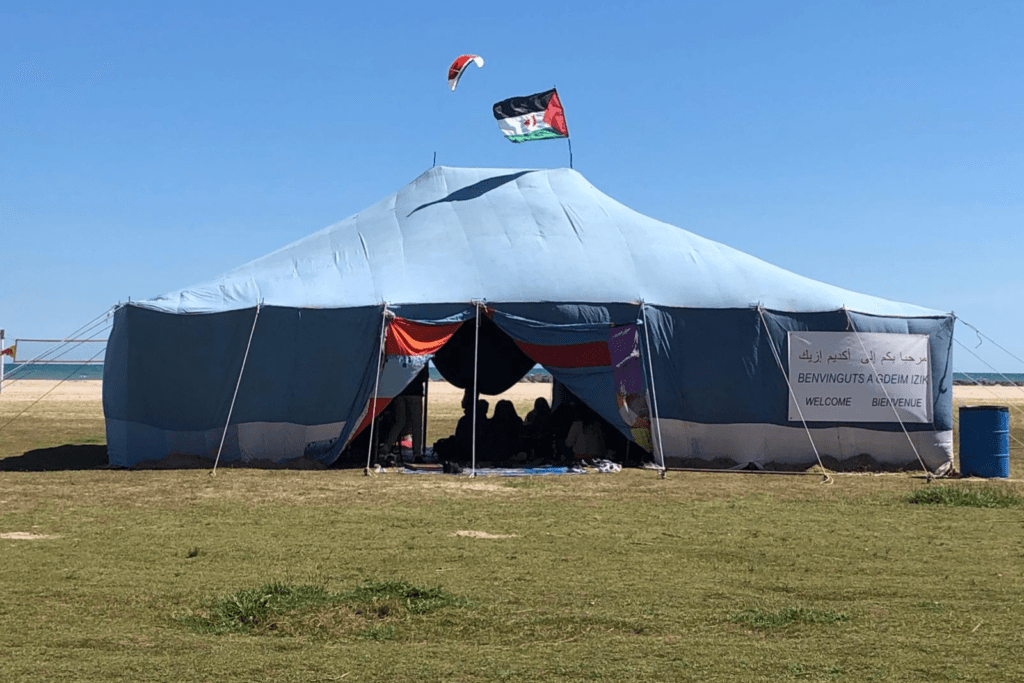
The recent humanitarian tragedy in Ceuta has plunged Spain into a political crisis that renders visible the afterlives of its colonial presence in Africa. Indeed, the sudden arrival of close to 70.000 people to the shores of Ceuta this summer was preceded by another 8000 who had arrived on May 17, 2021, following a diplomatic dispute between Spain and Morocco over the pending decolonisation of Western Sahara; a territory currently under Moroccan occupation and listed as one of 17 remaining non-self-governing territories by the United Nations. Although the conflict over the Western Sahara is most often described as “stalled” into a zero-sum game between Morocco and the Sahrawi National Liberation Movement, known as the Polisario Front, from an anthropological perspective, the conflict is far from paralyzed since the Polisario has been able to sustain its resistance, socially reproducing its project of Sahrawi nationalism to this day.
Circular migration between Spain and Sahrawi refugee camps in Algeria constitute an increasingly important terrain for the Polisario’s social reproduction. This talk describes how a growing Sahrawi diaspora is intimately connected to the existence of a large network of solidarity with the Polisario Front that has created significant kinship-like ties between Spanish [Castilian, Catalan, Andalucian, Galician, Basque, Canarian] and Sahrawi families through humanitarian projects that have fostered hundreds of thousands of Sahrawi children in Spain since 1979, supported the migration and higher education of thousands of these refugees once they become adults, and preserved some visibility for the Sahrawi cause within Spain’s public sphere. It describes how the range of citizenship practices currently pursued by Sahrawi migrants overlaps with a highly diverse range of Spanish political agendas that have little in common other than their shared dissatisfaction with a post Francoist establishment. In this way, the talk explores how Spanish-Sahrawi relations are implicated in the production and reproduction of political imaginaries that aspire to see contemporary European and Northwest African cartographies radically reconfigured.
About the Speaker
 Vivian Solana is an Associate Professor at Carleton University’s Department of Sociology & Anthropology in Ottawa, Canada. Her long-term ethnographic research in Sahrawi refugee camps focused on the forms of female political labor that socially reproduce a Sahrawi revolutionary nationalism in exile. At present, she continues examining the reproduction of Sahrawi nationalism but this time through the lens of intimate Spanish-Sahrawi relations that support a growing Sahrawi diaspora in Spain. Her work can be found published in: American Ethnologist, LÓuest Saharien, History & Anthropology, PoLAR: Political and Legal Anthropology Review, The Comparative Studies of South Asia, Africa and the Middle East & MERIP.
Co-hosted by the University of Waterloo’s Anthropology Department.