


Photo credit: Prishaa Rajalathan
By Prishaa Rajalathan, MDP
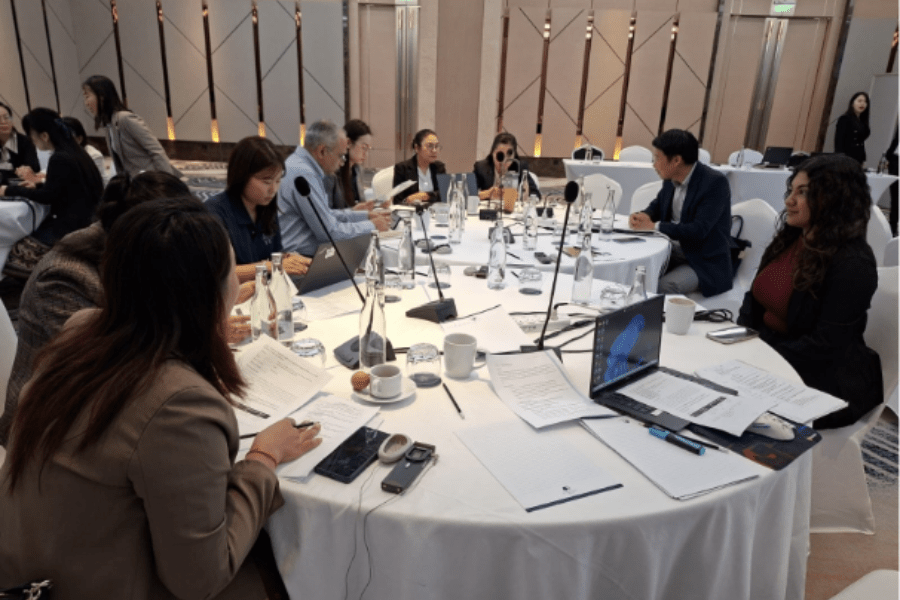
I had the opportunity to attend the Conference on Human Rights and Climate Change Adaptation in Vientiane, jointly organized by the Office of the United Nations High Commissioner for Human Rights (OHCHR) and the Ministry of Foreign Affairs of Lao PDR. It brought together government, UN agencies, civil society and partners to discuss something rarely addressed in climate conversations. What happens to communities when adaptation goes wrong, and how can we prevent it.
Lao PDR has been feeling the effects of climate change, unpredictable floods, prolonged droughts, and rising temperatures are putting pressure on farmers, rural communities, and ecosystems. The question guiding the conference was not whether to act, but how to act fairly, inclusively and based on human rights. As Mr. Bakhodir Burkhanov, the UN Resident Coordinator, put it, adaptation is not only about infrastructure or technology, it is about “ensuring that people, especially those most affected, can participate meaningfully in decisions that shape their future.” You can read his full remarks here.
I attended during my internship at the Climate and Sustainable Finance Hub, established by UNDP and the Government of Lao PDR and hosted by the Ministry of Finance.
Climate risk is about who is in harm’s way and how equipped they are to cope. The conference made clear that vulnerability is not random, and that adaptation and human rights go together. The 2025 Advisory Opinion of the International Court of Justice reinforced this legally: states must account for human rights when implementing climate treaties. On 20 May, the day before this conference convened, UN member states adopted a General Assembly resolution welcoming that opinion, with 141 voting in favour and Lao PDR among them. This reframes what Lao PDR’s National Adaptation Plan and NDC actually are, not just technical documents, but decisions about who is protected, who is not, and who is accountable when something goes wrong.
One session that stuck with me was on maladaptation, how even a well funded, well-intentioned project can hurt the communities it is meant to benefit. Think of relocations that cut communities off from their land, gender-blind flood responses, or infrastructure built without the consent of those who depend on the resources. As one session noted, “the cheapest and most effective safeguard is a meaningful conversation with affected communities prior to the design of a project.”
The workshop introduced the Global Goal on Adaptation, which now operates with indicators adopted at COP30 in Belém, the first common international approach to measuring adaptation, including rights indicators. The COP30 decision goes further in its paragraph 10, which names gender, human rights and the contributions of ethnic communities, women and youth, giving those indicators a clear footing. It becomes more than an outside requirement, strengthening action upfront through impact assessments, community engagement and livelihood plans co-created with people, not for them.
Two themes recurred throughout the sessions. The first was participation, and the difference between engagement and box ticking. No national plan can replace the knowledge that women, ethnic communities, youth and local populations have about their environments. Free, Prior and Informed Consent (FPIC) was emphasized as a practical way to do this, especially on land and natural resources, and is an ongoing process rather than a one-time sign-off.
The second was accountability. Good policy does not mean anything without ways to identify whether they work, or for communities to voice concerns. That means disaggregated data by gender, ethnicity, age and geography, and grievance processes that are truly accessible, not just available. It also means protecting community activists and human rights defenders so they are not seen as a threat. The UN Declaration on Human Rights Defenders and clear no-reprisal commitments are the safeguards meant to do this.
What Comes Next: The conference ended with an ongoing commitment that this discussion would continue at the provincial level, where the matter is not theoretical but lived and felt by vulnerable communities. That follow-through is what matters most.
For the Hub, the link is clear, its work can mainstream rights-based principles into climate finance design, monitoring and reporting, and partners across government and the UN are encouraged to engage with it. Mobilizing finance for resilience means little if the communities most exposed to climate risk are not at the center of how it is used. A climate plan is only as strong as the communities it is built with, not for.
The opinions expressed in this article are those of the author(s) and do not necessarily reflect the views of the BSIA, its students, faculty, staff, or Board of Directors.