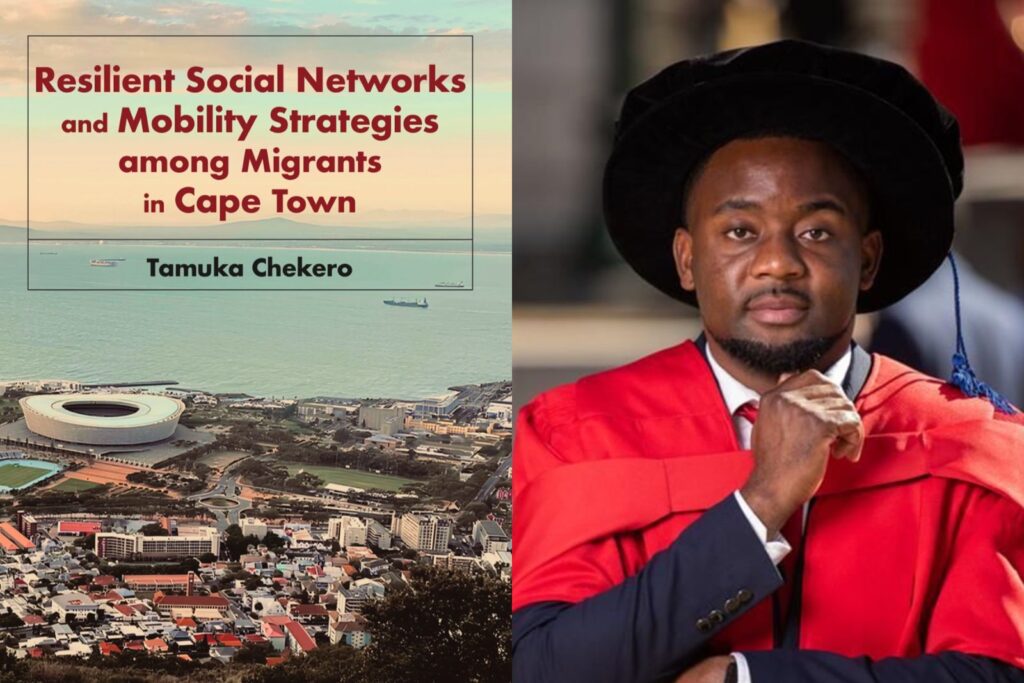
Built on the “mobility turn,” Tamuka Chekero’s book, Resilient Social Networks and Mobility Strategies among Migrants in Cape Town, examines how African migrants navigate precarity through dense, diverse social networks that extend beyond state-imposed classifications of nationality or legal status. He argues that labels such as Zimbabwean migrant, Congolese migrant, Nigerian migrant obscure the richness of relationships migrants cultivate to sustain livelihoods, negotiate belonging, and respond to structural exclusion in Cape Town’s postcolonial urban landscape. Drawing on ethnographic research, he traces migrant mobility across neighbourhoods, workplaces, transport routes, and convivial spaces, showing how social networks function as tools of survival and strategic (in)visibility. His analysis is augmented by African concepts, including hushamwari (friendship) and kuhanyisana (helping each other to live), which illuminate mutual support, solidarity, and cooperative action within migrant communities. He combines these with ubuntu, conviviality, incompleteness, and nimble-footedness to theorise everyday strategies of resilience, gendered mobilities, and crisis adaptation, such as during the COVID-19 pandemic. His work contributes by reconceptualising migrant agency beyond nationality, integrating Southern African epistemologies into migration studies, and offering evidence for policy approaches that prioritise inclusion over enforcement. By centring migrant sociality, he shows how mobility, resilience, and urban belonging are co-constructed and sustained across Cape Town’s complex social and spatial landscapes.
About the Speaker
Tamuka Chekero is an anthropologist and policy researcher who studies migration, governance, and social change in African cities. His work challenges the use of nationality as the primary lens for understanding migrants, showing how this colonial framing obscures the density, diversity, and resilience of networks that migrants cultivate to survive. His work focuses on how mobility, grassroots entrepreneurship, and social relations shape inclusive governance and everyday life. Tamuka’s research is informed by ethnographic methods and enriched by African concepts and practices such as hushamwari and kuhanyisana, which illuminate the ways migrants support one another and navigate complex urban environments. He is currently a Consultant at the Institute for Justice and Reconciliation and a Research Associate at the Gordon Institute of Business Science (University of Pretoria), conducting interdisciplinary research that bridges lived experience and policy analysis. He holds a PhD in Anthropology from the University of Cape Town. He has held research positions with the World Bank Group as an Africa Research Fellow in Washington, DC, and with regional initiatives across Southern Africa. Tamuka has published extensively in academic journals and authored a monograph on migrant social networks in Cape Town.