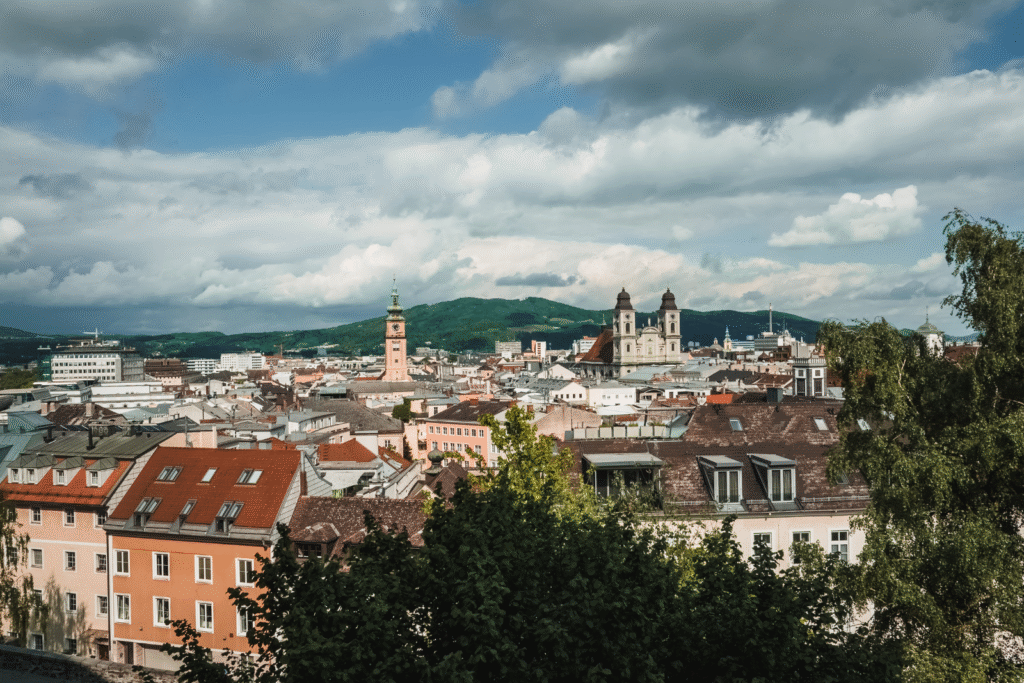
Extraction and confined labor are typically associated with colonialism, occluding their broader geographical, historical, and contemporary relevance. In Ayse Caglar’s talk, she asks: how could we go beyond the compartmentalized historiography of cities, (im)mobile labor, and displacement to unearth possible commonalities and contour lines connecting disparate periods, processes, institutions, and groups of actors in the making and remaking of cities? To answer this question, she suggests that we adopt a lens of expanded extractivism that allows us to bring into conversation the economies of (im)mobile labor, confinement, and governance of the displaced as inscribed in distinct periods and regimes (such as forced, displaced labor, guest worker, temporary, circular, migrant worker, asylum seeker/Refugee). By tracing the historical geography of a street in Linz, Austria starting from the WWII, she shows the continuities and mutations as detected in discourses and actors that regulate and finance the “care” of the displaced, as well as the spaces and practices of containment that is also visible today. Taking the perspective of longue durée thereby opens new ways of situating the current and ongoing commodification of the care and containment of migrants and refugees and the histories of confined labor within Europe.
About the Speaker
Ayse Caglar is a sociologist and an anthropologist. She is a University Professor at the Department of Social and Cultural Anthropology, University of Vienna and is a permanent Fellow at the Institute for Human Sciences (IWM) in Vienna. She held several visiting professorships and fellowships at different universities (Oxford, Stockholm, Zurich, Budapest) and institutions (Swedish Collegium for Advanced Study, Robert Schuman Centre for Advanced Study at EUI, Florence, The Institute for Advanced Studies in Vienna, Max Planck Institute, Göttingen, and at the Zolberg Institute on Migration and Mobility at the New School). She is a member of Academia Europaea. She has been co-directing the research platforms Europe-Asia Research Platform on Forced Migration at IWM with the Mahanirban Calcutta Research Group, as well as the Challenges of Urban Futures: Governing the complexities in European cities, at the University of Vienna.
Caglar’s work and publications focus on the interfaces of migration, urban restructuring, dispossession, displacement, confined labor, extractivism, and the transformations of statehood and the governance of cities. Most of her work is comparative and there is a special emphasis on disempowered cities, as well as cities that had been exposed to destruction and reconstruction particularly by wars. She has edited, co-edited and co-authored Locating Migration: Rescaling Cities and Migrants (Cornell University Press, 2010); Migrants and City-Making: Dispossession, Displacement, and Urban Regeneration (Duke University Press, 2018); Urbaner Protest. Revolte in der neoliberalen Stadt (Passagen Verlag, 2019); Displacements and Dispossessions (Refugee Watch 2020); Sites of Statelessness: Laws, Cities, Seas (Albany: SUNY Press (2024). A Special Issue “Situating global warfare in historical conjuncture” (2025) Focaal; A Special Issue on “Digitised Migration: Entangled and Uneven Landscapes” (forthc. 2025), International Migration.