


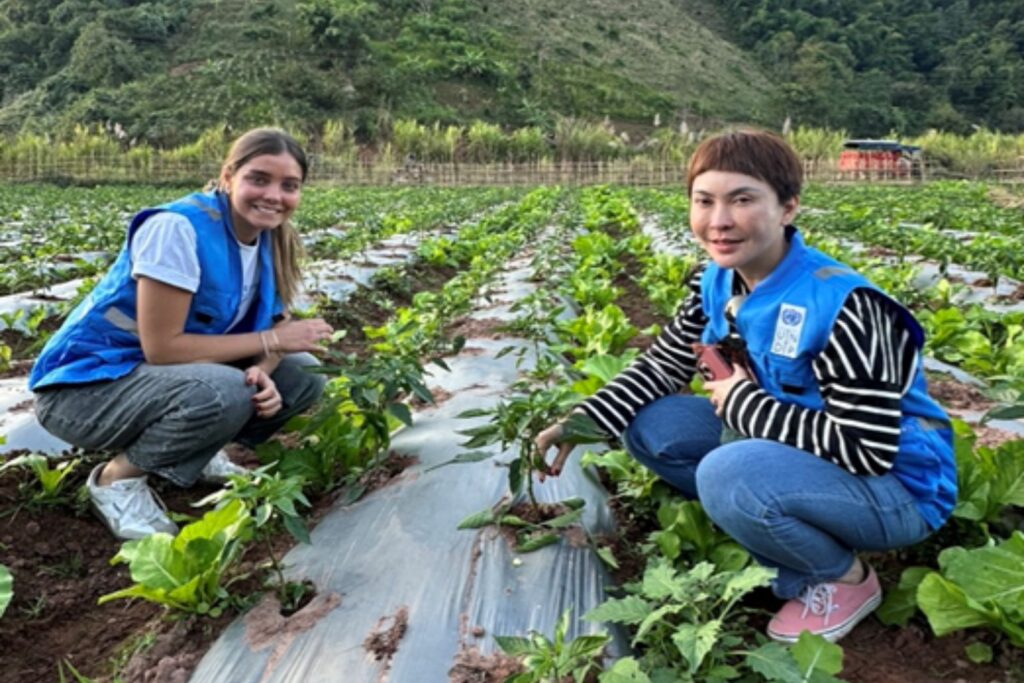
Photo credit: Sarah Hamm
By Sarah Hamm, MIPP
I ended my last blog by saying that living and working in Laos has been an invitation to explore a new way of working, thinking, and seeing the world, and as I sit down to write this second blog, that statement is even more true.
In December I had the opportunity to join a field mission for the Small Grants Programme (SGP). The purpose of the mission was to visit project sites supported by the SGP to evaluate how the grantees are using the funds and to ensure that the project activities are progressing in accordance with the agreed timelines and objectives. It also provided an opportunity to identify implementation challenges, understand lessons learned, and observe how these initiatives are affecting local livelihoods and community resilience.
Over the span of 5 days, we travelled by car through three northern provinces of Laos. The drive itself was an experience and it made Vientiane suddenly feel busy in comparison. As we drove north, the busy roads gave way to the windy mountain roads and small villages scattered throughout the countryside. Hours would pass between towns and it became clear how remote many of the communities are that we were visiting.
The villages we visited are all home to fewer than 700 people, most of whom live without electricity, no access to internet and some without even clean water. There really is no connection with the rest of Laos or the rest of the world. For many families, daily life depends heavily on agriculture and natural resources. During our five-day mission we barely scratched the surface of what life is like living so remotely, but it really made me imagine how the situation would change in the face of a natural disaster.
Our first stop in Xayabouly province brought us to Ban Tarling village, where the project focuses on producing bio-fertilizer using agricultural waste. This helps reduce reliance on expensive chemical fertilizers while improving soil health and agricultural productivity. In addition to supporting crop production, the funds were also used to strengthen livestock health by purchasing four different types of vaccines and training for community members on how to administer them. Our second stop took us further north to Hoayla village in Oudomxay province. Like the previous site, the core activities of this project also focused on strengthening agricultural resilience. Such as, training villagers on the production of bio-fertilizer, which helps improve soil health and addresses pest damage, an issue that community members identified as a major constraint on vegetable productivity and crop yields. To further support the crop growth, light blocking fabrics were distributed to help regulate moisture and temperature. Lastly, 30 bee boxes were provided to households to stimulate honey production and reduce pressure on forest resources. Perhaps the most striking visit was the last project site. Access to this site required a six-hour drive from Oudomxay province to Luangnamtha province, an hour ferry ride across a reservoir and finally a short walk up a steep incline to Ban Shanghan village. This village is the poorest village in the entire province and the challenges faced by the community were immediately visible. The project here focused on improving basic infrastructure at the local school, such as renovating the student dormitory and kitchen, as well as the construction of a new groundwater well. The improvements supported by the SGP in this village was nothing short of instrumental.
Before this mission, my understanding of development work was largely theoretical, shaped by the reports or the videos I saw. Although the purpose of the trip was technically to support monitoring and evaluation, the experience became far more meaningful to me. Seeing these projects firsthand allowed me to witness the real impact they have on the lives of community members. I left the mission with a new sense of perspective, one I know I did not have before and with a deeper appreciation for the resilience of the communities we visited. It was an amazing opportunity to see development work unfold beyond the office and directly within the communities it aims to support. The lessons I learned and the humility this experience brought will stay with me as I continue to navigate a life that I am incredibly fortunate to live.
The opinions expressed in this article are those of the author(s) and do not necessarily reflect the views of the BSIA, its students, faculty, staff, or Board of Directors.