


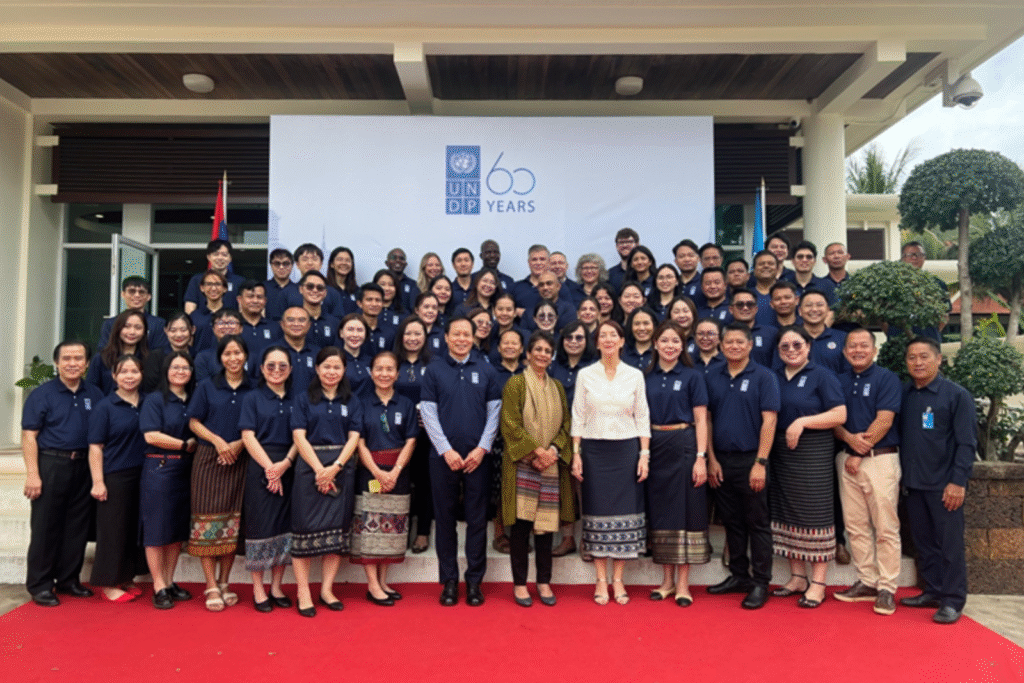
Photo credit: Sierra Van Tent
By Sierra Van Tent, MIPP
Reflecting on my first six weeks in Lao PDR as a Research and Data Analysis Intern with UNDP, I can confidently say this has been one of the most enriching personal and professional experiences I’ve had. In a short time, I’ve learned a great deal and had the privilege of meeting many inspiring and dedicated individuals who are deeply committed to making a difference here.
I am working in the Inclusive Growth Unit (IGU) at UNDP, specifically focused on the National Planning and Financing for Inclusive Development (NPFID) project. NPFID is a massive project led by the Ministry of Finance with UNDP providing technical support, and to say the team here is busy would be an understatement. My arrival in Laos coincided with a visit from the UN Assistant Secretary-General and Regional Director for Asia and the Pacific, Kanni Wignaraja. Starting at this time meant hitting the ground running, but it was also an incredible stroke of good luck to meet her and take part in a Baci ceremony on my first day, which is a traditional Lao ritual of welcome and good fortune.
Now that I’ve started to settle into my role here, much of my time is spent in meetings with line ministries, development partners, and government officials. I’ve also been fortunate enough to travel on mission to the beautiful Vang Vieng, which has definitely been a highlight of my experience so far! No two days look the same, which is something I really enjoy. The NPFID project is broad in scope, meaning I work on a wide range of activities from supporting government workshops on strengthening data monitoring and evaluation frameworks to helping design a programme that builds technical skills and professional experience for recent Lao university graduates.
A constant theme across much of the work at the Lao Country Office has been adapting to the transitions happening in Official Development Assistance (ODA). Many projects at UNDP Lao PDR have relied heavily on funding from USAID, which will be coming to an end after 2026. This means that the country office needs to look for alternative and more creative forms of funding to meet its development needs; and Lao PDR is not the only country office facing this dilemma. The ODA environment is shifting quickly and dramatically. For somebody hoping to work in the international organization system, this means operating in an environment that looks very different from what it once was. I graduated only recently, yet the environment I’m working in already feels markedly different from the one I studied in class, and even from the one I researched when I first accepted my placement. These transitions are visible in our daily work, from how projects are designed to how reporting frameworks are structured. There is a growing emphasis on measurable impacts and results language, partnerships with non-traditional donors such as the private sector, and a shift from external funding to national ownership. For young professionals like myself, success in this kind of environment will depend on being resourceful and creative both in how we use our resources and in how we design policies that can create impact beyond the lifespan of a funding cycle.
The opinions expressed in this article are those of the author(s) and do not necessarily reflect the views of the BSIA, its students, faculty, staff, or Board of Directors.