


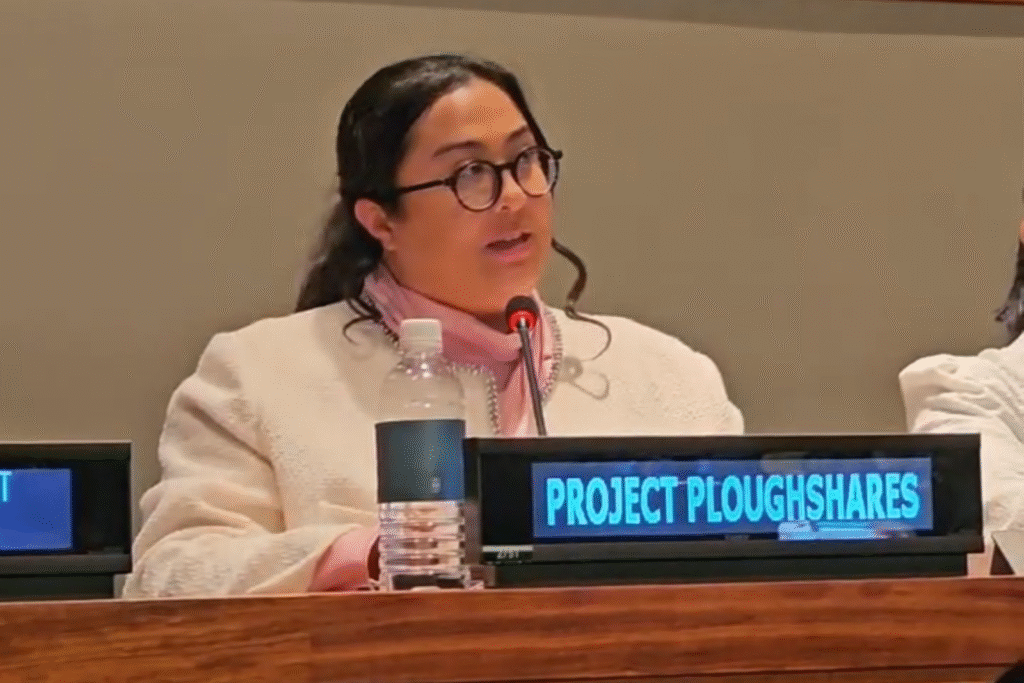
Photo credit: Kianna Low-A-Chee
By Kianna Low-A-Chee, MIPP
Since September, I have been working with Project Ploughshares researching AI and emerging technology. On the 17th of October 2025, I had the privilege of delivering a joint statement on behalf of Project Ploughshares and many other civil society organizations to the United Nations 80th First Committee Session for Disarmament and International Security. The statement was written by Jessica West and Philip Carrey. As I read it, I found myself reflecting on a common theme between space security and emerging technologies and AI – the need for cooperation and trust to maintain peace in orbit and on Earth.
When I arrived at the United Nations headquarters in New York City, I felt a flurry of excitement and nervousness. I had not spoken to such a large audience prior to this experience, but I was excited for the chance to present such important work. The weaponization of technologies has become a prominent issue, which makes the work of Project Ploughshares and other civil society organizations all the more important. The voices of these organizations are vital to the global governance of arms control: shaping debates, influencing resolution language, and inspiring new resolutions.
I had the opportunity to attend both the morning and afternoon sessions, which consisted of state and civil society statements on a variety of topics related to disarmament. As a graduate of political science and a Master of International Public Policy, I had studied and written reflection pieces on meetings such as these ones, but this was my first opportunity to witness and participate in them. A consistent theme arose: the need for greater cooperation in the name of peace.
Mistrust and conflict are plaguing society, but the First Committee Session for Disarmament and International Security should inspire hope. Both civil society and state delegates from around the world gathered in one space with the goal of working toward a more peaceful world.
The opinions expressed in this article are those of the author(s) and do not necessarily reflect the views of the BSIA, its students, faculty, staff, or Board of Directors.