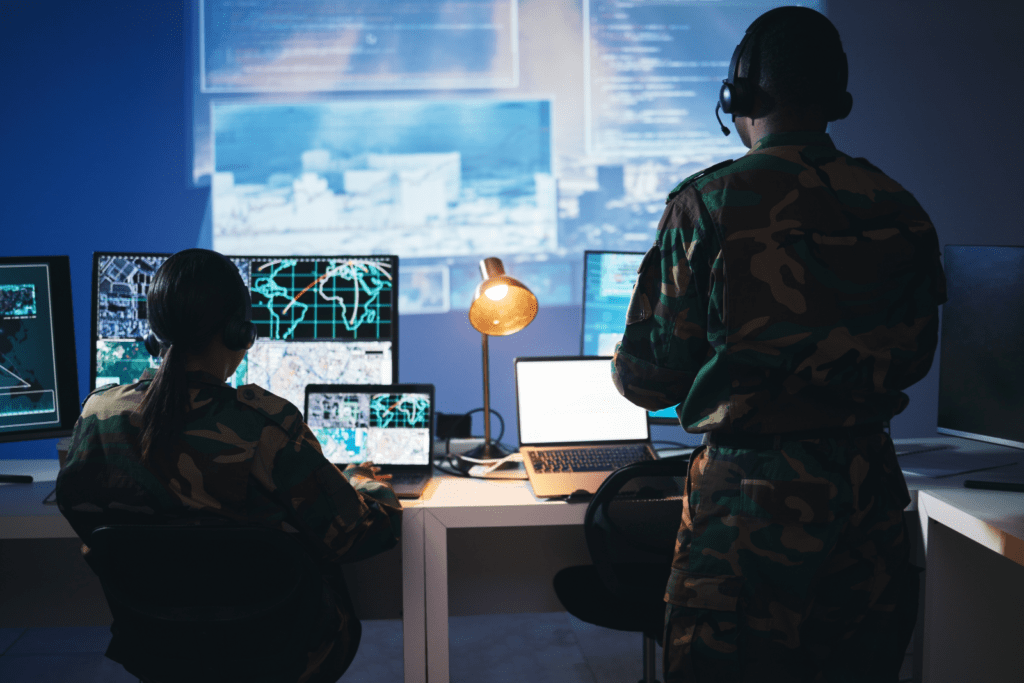
Reports of actors employing AI and large-language models are emerging from battlefields worldwide, raising critical concerns around the role of humans in decision-making on the use of force. As militaries increasingly integrate AI into their command structures, ensuring meaningful human oversight in warfare becomes more pressing. Meanwhile, global debates on governing military uses of AI, ongoing at the United Nations and other forums, continue to deliberate whether new measures are needed to address challenges associated with AI in warfare. A key challenge of those discussions is how the principle of human oversight should be implemented in practice.
Building on these developments, this panel brings together experts on AI in international security to discuss three key questions. First, how are AI systems such as large-language models currently used in warfare, and what are the implications for human judgement in military decision-making? Second, what are the viable paths forward for governing AI in the military domain, especially in terms of putting broader principles into practice? And third, what should be Canada’s role in military AI governance debates, as it seeks to leverage its middle power status in global affairs? The panel will be followed by a Q&A session with the audience.
About the Panelists
 Morgan Flom is a philosophy graduate student pursuing a two-year master’s degree at the University of Guelph. For his thesis, he is researching the ethical and epistemological impacts of artificial intelligence in the military and national security arenas. Morgan is entering academia after working in various technology roles in the U.S. national security and sports analytics industries. He leverages his 15+ years of experience working as an intelligence officer, data analyst, product owner, and entrepreneur, to provide a grounded perspective on the on-going and future effects of data-driven operations and automated algorithmic decision-making. Additionally, Morgan is a current Digital Policy Hub fellow at CIGI. This endeavor allows him to explore the faults and dangers of technology and data driven workflows in national security from a policy focused perspective and aims to offer rigorous and actionable risk-reduction recommendations to relevant decision makers.
 Sara Matthews is Associate Professor in Communication and Cultural Studies at Wilfrid Laurier University, as well as a Graduate Faculty member in the MA in Communication Studies, the MA in Cultural Analysis and Social Theory, and the PhD in Global Governance at the Balsillie School of International Affairs. Sara’s research and teaching are interdisciplinary and consider the dynamics of conflict and social change. Working primarily in the field of research-creation, her projects explore the relations between visual culture and martial politics as well as how communities craft creative modes of relationality and survival in response to practices of state securitization. Along with co-author Dr. Nathan Rambukkana, Sara is developing a manuscript titled Unfolding AI: Platforms, Affects, and Human–Machine Intimacies (forthcoming 2026). The book tackles the emergent topics of AI and robotics through the framework of Human-Machine Intimacies.
 Branka Marijan is a Senior Researcher at Project Ploughshares, a Senior Fellow at the Centre for International Governance Innovation (CIGI), and a Lecturer in the Master of Global Affairs program at the Munk School of Global Affairs and Public Policy at the University of Toronto. Her work sits at the intersection of artificial intelligence, emerging technologies, national security, and international governance. She specializes in the governance of military AI, autonomous weapons systems, and responsible innovation, with a broader research agenda examining how technological change is reshaping security, defence policy, and geopolitical competition. She holds a PhD from the Balsillie School of International Affairs specializing in conflict and security. Her commentary and research have appeared in academic journals, policy publications, and national media, where she writes and speaks on AI governance, defence innovation, international security, and the changing character of warfare.
 Anna Nadibaidze is a Balsillie Scholar at the BSIA and a Postdoctoral Researcher at the Center for War Studies, University of Southern Denmark (SDU). She investigates artificial intelligence (AI) technologies in international security and the global governance of military applications of AI. Anna holds a PhD in political science from SDU. Her research is part of the Independent Research Fund Denmark-funded HuMach project, as well as the European Research Council-funded AutoNorms and AutoPractices projects. She regularly attends and speaks at key global events on military AI, such as debates at the United Nations or the Responsible AI in the Military Domain (REAIM) summits. Her work has been published in journals such as Contemporary Security Policy, Big Data & Society, and European Journal of International Security.