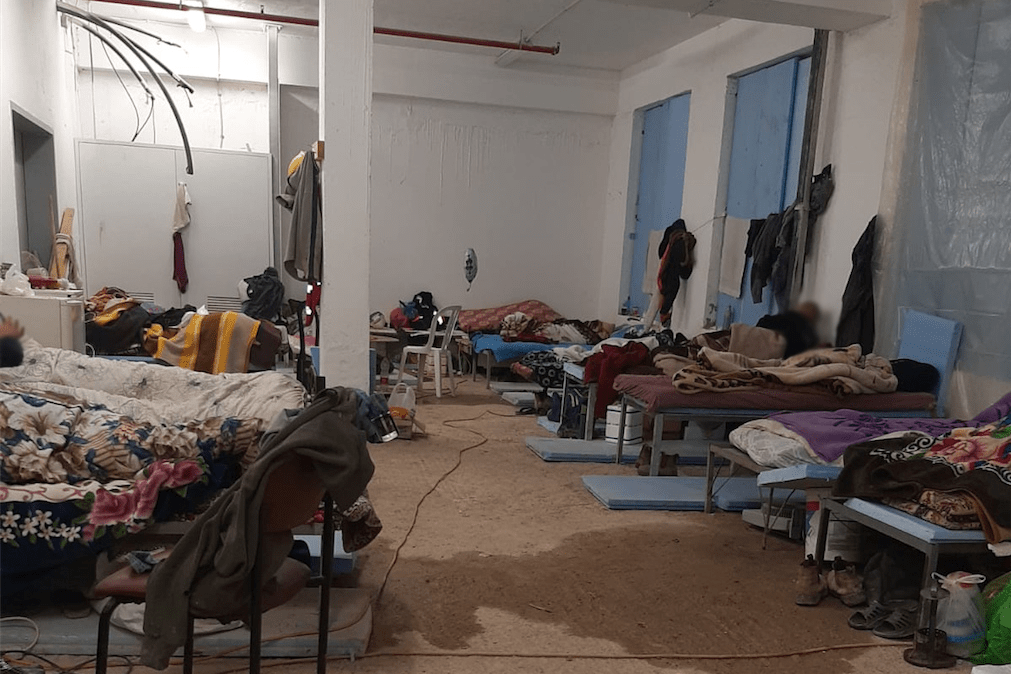
This talk presents a historical-anthropological examination of Israel’s reliance on Palestinians from the occupied territories (West Bank and Gaza) as construction workers, focusing on the long-standing policy prohibiting them from staying overnight inside Israel and the wide-ranging consequences of how this reliance and prohibition interact. Based on an ongoing research project with Yael Berda, this work contributes to the study of colonial infrastructures, specifically in relation to racial capitalism and statecraft calibrations between economic interest, political agenda, and national ideology. Drawing on archival research and interviews, this research theorizes the prohibition as a “logistical valve” that correlates multiple colonial infrastructures of population management. The valve enables the efficient extraction of Palestinian labor without limiting “security” measures of surveillance and control. Thus, the nocturnal prohibition crucially influences Palestinian social and economic life. The presentation provides a historical overview of the logistical valve, highlighting three critical phases: (i) the late 1960s and early 1970s when the nocturnal prohibition took shape; (ii) the 1980s, a period when the figure of the Palestinian construction worker became a prominent symbol in Israeli Hebrew culture; and (iii) the policy shift during the first COVID-19 lockdown, a seemingly exceptional moment that exposed how the occupation structure dynamically aligns with neoliberal economy. The conclusion will contextualize Israel’s policies regarding Palestinian labor since October 2023.
About the speaker
Omri Grinberg is a political-legal and socio-cultural anthropologist who studies representations of violence, focusing on the production and circulation of human rights testimonies. His ethnographic and historical research examines dynamics between bureaucratic statecraft and NGO legal advocacy, and the contested roles of archives in truth-making deliberations. He holds a PhD in Anthropology and Jewish Studies from the University of Toronto, where he held a Vanier Graduate Scholarship. His work has been published in such journals as Anthropologica, International Journal of Human Rights, and History & Memory (forthcoming). Parallel to academic research and teaching, he works as a consultant with human rights NGOs.