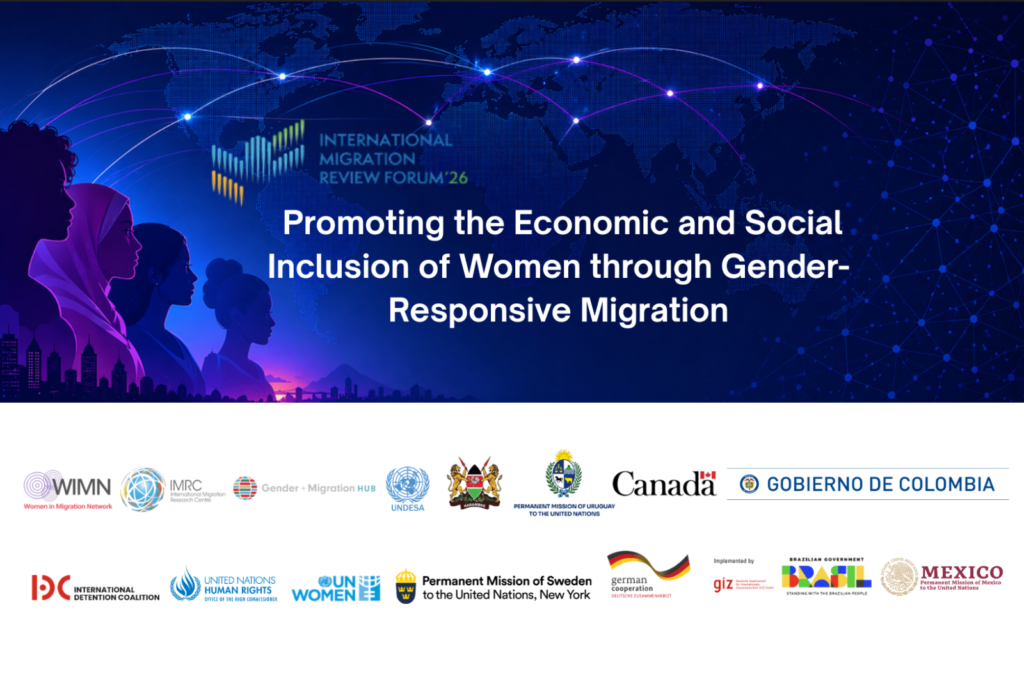
This side event is hosted by the International Migration Research Centre, taking place at the 2026 International Migration Review Forum at the UN Headquarters in New York City, USA.
PLEASE NOTE: The in-person portion of this event will take place at the Permanent Mission of Canada to the United Nations, 466 Lexington Avenue, 20th Floor, New York, NY 10017, USA.
The Global Compact for Safe, Orderly and Regular Migration (GCM) is built upon ten cross-cutting guiding principles, with the gender-responsive principle serving as a cornerstone for its 23 objectives. Since the inaugural IMRF in 2022, it has become increasingly clear that migration governance cannot be effective, safe, or orderly if it fails to integrate a strong gender perspective. Still, gender-based discrimination, unequal access to regular pathways, and the specific situations of vulnerability faced by women, girls, and gender-diverse individuals continue to undermine the integrity of the migration cycle and diminish the productive power of migration.
Too often, migration governance overlooks or ignores the distinct realities of women, girls, and gender-diverse individuals. Challenges of governing migration such as labour shortages, climate-induced displacement, or trafficking in persons cannot be faced without addressing the gendered nature of these phenomena, especially considering that women and girls are more frequently subject to labour exploitation and are the majority of victims of trafficking in persons. Moreover, gender-responsive and intersectional approaches are essential to achieving the ambitions of the 2030 Agenda. In this regard, advancing gender equality in migration governance has been critical toward expanding equal access to education, enhancing women’s participation in labour markets, and contributing to more inclusive and sustainable economies along migration routes. Migrant women have been responsible for approximately half of global remittances (USD$601 Billion in 2016); and increased, and more equitable, labour market participation strengthens the developmental impact of migration – providing evidence that integrating an intersectional lens into migration governance is critical to addressing structural inequalities and strengthening economies.
This side event will not only underscore the urgency of “holding the line” on gender-responsiveness commitments within the IMRF, but also highlight and facilitate the exchange of promising, evidence-based practices that demonstrate how gender-responsive migration policies can deliver tangible benefits across sectors, from protection and inclusion to sustainable development and economic growth. In particular, it aims to highlight how advancing gender equality in migration governance is closely linked to increased women’s inclusion in education and labour markets, which in turn enhances the developmental impact of migration. The undervaluation of women’s time and work in the labour market results in massive global economic losses. It is estimated that closing the gender gap just in OECD countries can raise global economic activity by 7%, equivalent to USD $7 trillion – imagine the economic prosperity if the gap is closed globally and the productive power of gender-responsive migration is harnessed.
It is imperative that member states continue to reaffirm political commitments while working to ensure their implementation through practical tools, accountability frameworks, and institutional mechanisms. By creating space for dialogue and exchange, this side event will explore how to bridge the persistent gap between principle and practice, and how to translate gender-responsive and intersectional approaches into concrete social and economic impacts.
Registration is now closed.
Organized and co‑sponsored by: the Governments of Brazil, Canada, Colombia, Kenya, Sweden and Uruguay and Mexico, the Deutsche Gesellschaft für Internationale Zusammenarbeit (GIZ), UN Women, United Nations Department of Economic and Social Affairs (UNDESA), the Office of the United Nations High Commissioner for Human Rights (OHCHR), Gender+Migration Hub, Women in Migration Network (WIMN), International Migration Research Centre, and the International Detention Coalition (IDC).
View all other IMRC affiliated events taking place at the 2026 International Migration Review Forum here.