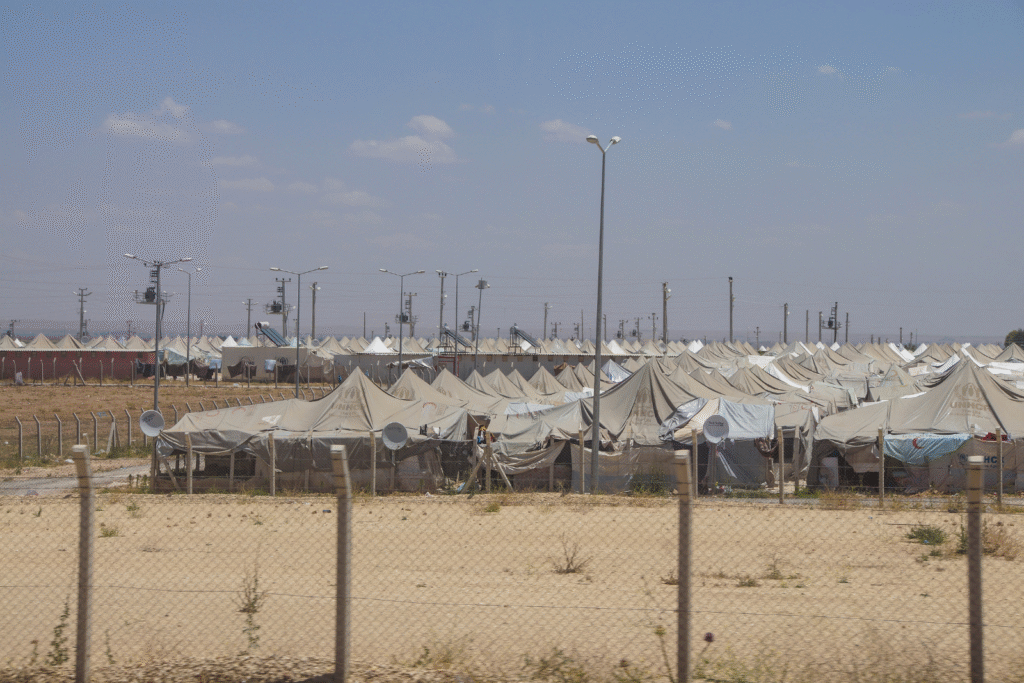
Over the last decade ‘stepping into the lives of refugees’ and ‘walking in their shoes’ through refugee simulations have been an emerging humanitarian advocacy strategy. Despite their popularity, simulated refugee camps are neglected sites in border studies as well as in International Relations more broadly. This paper seeks to introduce a new area of inquiry in our discussion of borders by exploring how these simulations perform new territories and how these new territories empower or destabilise borders. The analysis shows that these simulations are based on the belief that they can act as spatial transmitters of empathy. However, such mode of encounters can be self-defeating. While they seek to challenge practices of securitisation, they may empower mobility inequalities and power hierarchies that are embedded in the structures of humanitarian borders.
About the Speaker
 Umut Ozguc is an International Relations (IR) scholar. Her work engages with critical border studies, International Political Sociology (IPS), and critical methods in International Relations. She is interested in understanding multiplication of borders, bordering technologies and mobility injustices. Her current research focuses on AI and automated systems in migration and border governance. Umut is the Program Leader for Digital Border and AI Adaptation, at the Center for Applied Artificial Intelligence and Process Automationat Macquarie University. She is the co-founder/ co-convenor of Australian Critical Border Studies Network. She was co-chair of Women’s Caucus Australian Political Studies Association(APSA) from 2023-2025. She completed her postdoctoral fellowship at UNSW Canberra on her project on “Posthuman Borders” (2019-2020). Her project, “Mobility injustices, racialised bodies, and Australia’s pandemic borders”, is the winner of 2022 ANU Freilich Project for the Study of Bigotry Early Career Research Grant.