


Photo credit: Frances Northeast
By Frances Northeast, MAGG
Sousdei!
It has been two months since I first joined WFP Cambodia, and the time has flown by! Since my last blog post, I have completed and submitted a report to a donor country, and I am currently working on the draft report for another donor country. I was also able to sit in on a quarterly coordination meeting with our implementing NGO partners to receive updates and provide feedback on the program’s progress. Soon, I will start supporting the School Feeding Team with the Annual Country Report, a document that will be made public by WFP that gives an update on the state of Cambodia’s work in 2025.
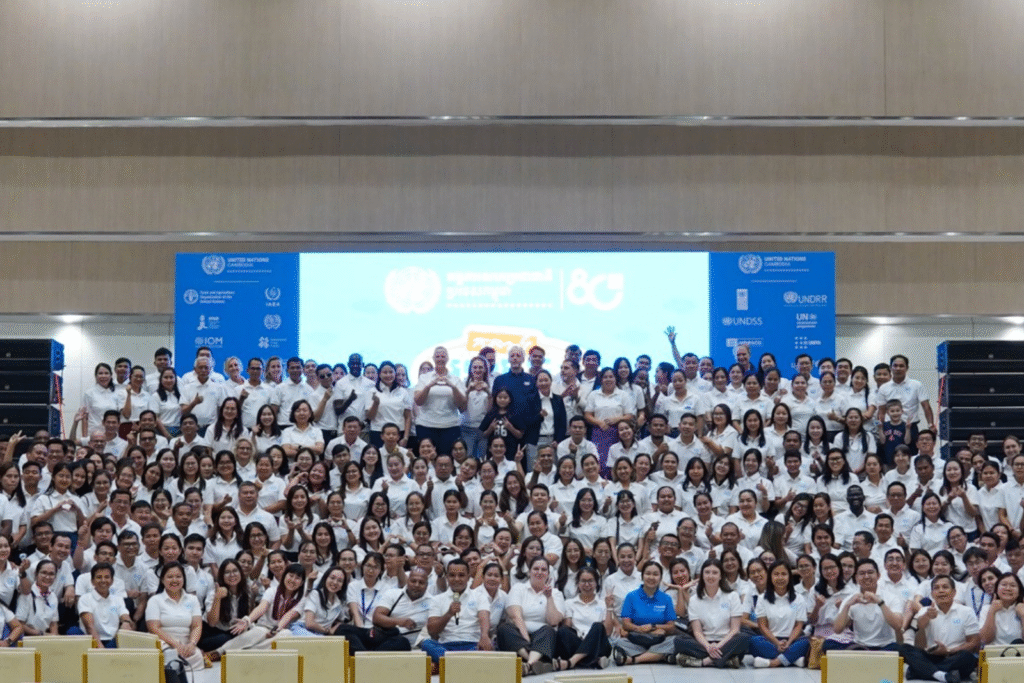
In addition, on October 24, UN day, I went to a countrywide townhall event with some of the WFP team. All the UN organizations in Cambodia were invited to participate. It was a powerful and much needed reminder that while international development funding is being cut at unprecedented levels, there are still so many dedicated individuals working together for a better future.
Outside of work, I had a friend come and visit Phnom Penh during the Water Festival. The Water Festival is an event that celebrates the end of the rainy season, and the gratitude and connection felt between people and the water. Typically, the main festival is held in Phnom Penh along the riverside, where dragon boat races are held, floats are paraded down the river, and the city has a very festive feel complete with fireworks, concerts, and markets. Unfortunately, due to the Cambodia-Thai border conflict, the main festival was canceled, but many other provinces still hosted their own events.
While my friend was in town, we did all the tourist sightseeing activities like visiting Wat Phnom (a Buddhist temple), the National Museum, the Royal Palace, the Silver Pagoda, and the Independence Monument. We also went to Phnom Tamao Wildlife Rescue Centre, a government supported facility that houses animals confiscated from the illegal animal trade, animals that have been rescued from traps, and animals that pose a safety risk to the communities they are near. While some animals cannot be rehabilitated and released, the goal is to reintegrate as many animals as possible, and to ensure that those who cannot be released have full lives at the centre.
My friend and I also visited the S21 Tuol Sleng Genocide Museum. While the genocide and the Khmer Rouge regime was at its height between 1975 and 1979, many organizations, including the UN, and countries recognized the Khmer Rouge as the country’s only legitimate government until the 1990s. The Khmer Rouge were responsible for the deaths of an estimated 1.5 to 2 million Cambodians, a figure that accounted for around a quarter of the population at the time. In S21 alone, there was an estimated 12 000 to 20 000 people who were imprisoned, and only a total of 12 people survived. S21 is the most infamous detention and interrogation centre that was part of a network of hundreds of prisons across the country, and it has since been designated as a UN World Heritage Site by UNESCO. It was a deeply disturbing but necessary experience to have had.
The Cambodian government actively encourages foreign tourists to visit these memorials and learn about the devastating history. The museum implores those who visit and learn that they now have a responsibility to share what was learned, something I hope to have helped do by including a short overview of it in this post. Considering we are only around 50 years removed from the atrocity, it is important that I visit this site to understand the historical context in which I am working.
The country is still impacted by the legacy of the regime, and I strongly encourage those reading this to learn more about the Cambodian Genocide, especially during this time where there are multiple global conflicts and many humanitarian crises.
Frances
The opinions expressed in this article are those of the author(s) and do not necessarily reflect the views of the BSIA, its students, faculty, staff, or Board of Directors.